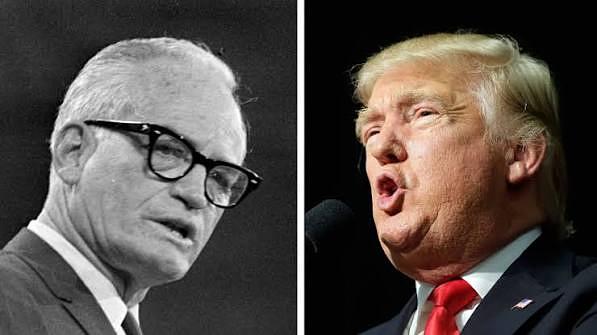
From Goldwater to Trump: Has America Decided Moderation Is a Vice?
"Extremism in the defense of liberty is no vice. And moderation in the pursuit of justice is no virtue."
When Barry Goldwater accepted the Republican presidential nomination in 1964, those words electrified conservatives and horrified much of the political establishment. Written by speechwriter Karl Hess, the line became one of the most famous—and controversial—statements in modern American politics.
That quote has echoed through American politics for more than 60 years and provides a perfect frame for your argument because today both parties increasingly celebrate ideological purity while treating moderation as suspect.
At the time, many Republicans feared Goldwater had moved the party too far to the right. Democrats painted him as dangerous. He lost the general election to Lyndon Johnson in a historic landslide.
Yet history tells a more complicated story.
Goldwater didn't simply lose an election. He launched a movement. His unapologetic conservatism laid the intellectual foundation for Ronald Reagan's rise sixteen years later and fundamentally reshaped the Republican Party.
Today, more than sixty years later, America finds itself asking a different question:
Has Goldwater's philosophy escaped the confines of conservatism and become the operating principle of both political parties?
The New Politics of Purity
The American political center hasn't disappeared.
But inside both parties, it has become increasingly difficult to win from the center.
Republican primary voters continue rewarding candidates who embrace Donald Trump's confrontational style and populist message. Texas Attorney General Ken Paxton's defeat of longtime Senator John Cornyn is only the latest example that establishment credentials often matter less than ideological alignment with the party's base.
Democrats are experiencing their own version of this phenomenon. Progressive challengers increasingly argue that compromise has produced too little change, while many primary voters have grown skeptical of traditional party leadership.
In both parties, moderation is frequently viewed not as wisdom—but as weakness.
Trump Didn't Invent This. He Perfected It.
Donald Trump transformed American politics, but he didn't create the conditions that made his rise possible.
Americans had already begun losing trust in Congress, the media, higher education, corporations, and even the Supreme Court. Social media rewarded outrage over nuance. Cable news rewarded conflict over compromise. Primary elections rewarded candidates who could energize the most committed activists rather than persuade undecided voters.
Trump simply understood this new political marketplace better than anyone else.
His success changed the incentives for every ambitious Republican.
His opponents, in turn, reshaped Democratic politics around resistance to him.
The result has been two parties that increasingly define themselves not merely by what they believe—but by what they oppose.
Character—or Tribalism?
Perhaps the most troubling trend isn't ideological.
It's cultural.
There was a time when ethical scandals, inflammatory rhetoric, or behavior that violated accepted political norms could end a political career.
Today, many voters first ask a different question:
"Is this my candidate?"
If the answer is yes, controversies are often dismissed as media bias, political persecution, or partisan attacks.
If the answer is no, those same controversies become disqualifying.
Ken Paxton's political resilience illustrates this reality on the Republican side. Democrats have experienced similar debates over controversial candidates whose supporters argued that larger political goals outweighed personal imperfections.
The standards themselves haven't necessarily changed.
Our willingness to apply them consistently may have.
Are We Becoming a Nation of Primary Voters?
General elections are still won in the middle.
Primary elections are often won at the edges.
That creates a powerful incentive for politicians to speak first to their party's most passionate supporters—and only later attempt to broaden their appeal.
It also helps explain why so many Americans tell pollsters they feel politically homeless.
Many are fiscally conservative but socially moderate.
Others are socially progressive but skeptical of expansive government.
Yet neither party consistently rewards candidates occupying that space.
Is This How Third Parties Begin?
History suggests third parties rarely win the presidency.
Ross Perot demonstrated that they can reshape political conversations, even without winning electoral votes. Theodore Roosevelt showed they can split major parties. Independent candidates can influence policy debates far beyond their vote totals.
Could today's political climate finally produce a durable centrist movement?
Perhaps.
But America's electoral system remains designed for two dominant parties.
The greater likelihood may be continued pressure inside each party rather than a successful alternative outside them.
Looking Toward 2028
The coming elections will test whether America has entered a permanent era of ideological politics.
Will Republicans continue following the path Trump charted?
Will Democrats continue rewarding candidates who promise transformational rather than incremental change?
Or will voters eventually rediscover the value of coalition-building, persuasion, and compromise?
Goldwater's famous declaration was once viewed as a bold challenge to conventional politics.
Today, it almost feels like a description of American politics itself.
The irony is striking.
Goldwater believed ideas should be pursued boldly.
America now seems to believe political victories should be pursued the same way.
The question for 2028—and perhaps for the next generation—is whether our democracy functions best when moderation is viewed as weakness, or whether history will once again remind us that governing is very different from campaigning.